Published March 1, 2026
By Anthony Pennacchi & Sons Team
Anthony Pennacchi & Sons Blog
Why Sacred Space Preservation Requires Master Masons
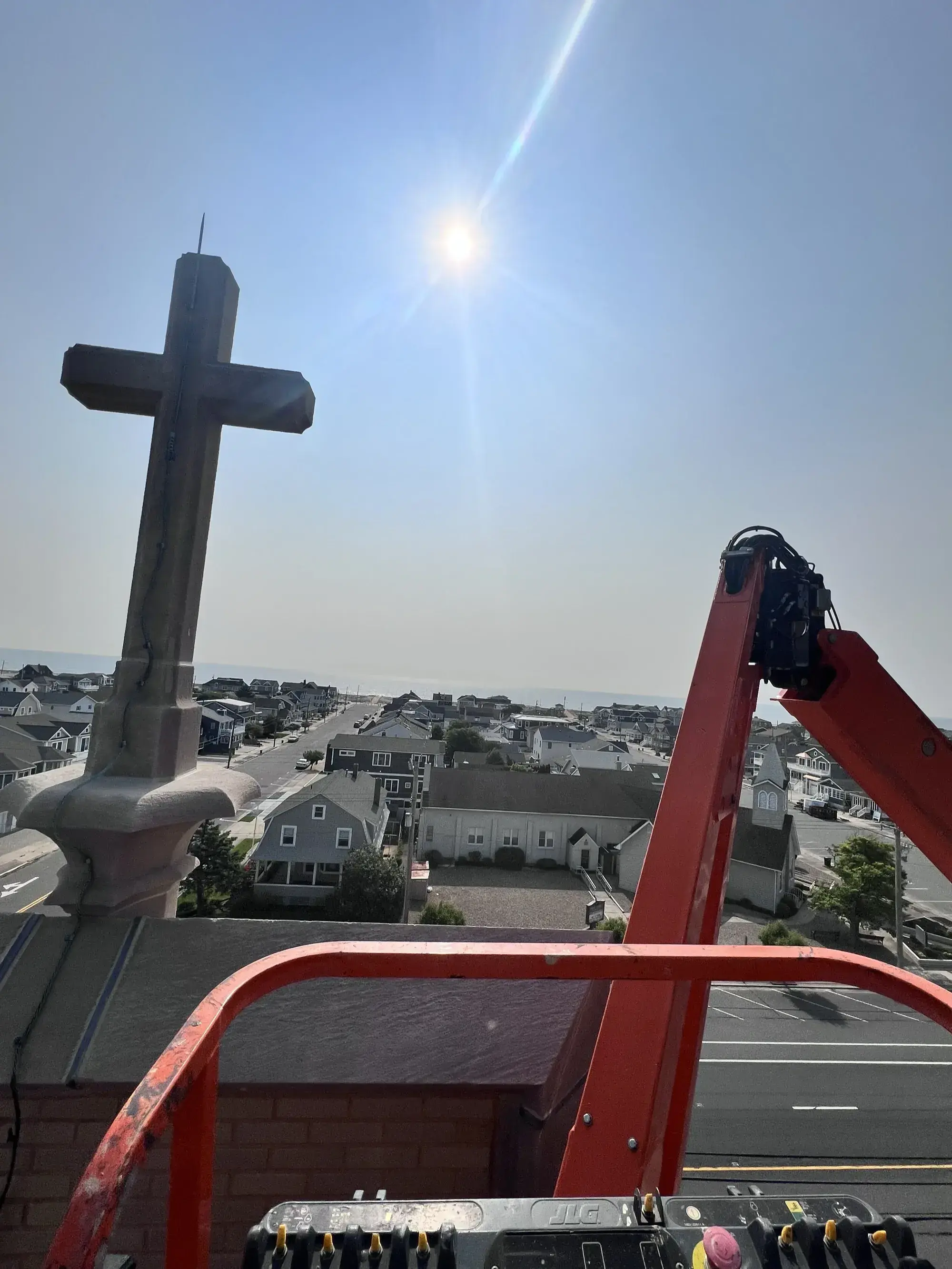
The fastest way to destroy a historic church is to hire a competent general contractor to restore it. They will use Portland cement on lime-mortar joints, power-wash delicate carved stone, and match mortar color by holding a sample up to the wall in sunlight. Within three years, the rigid cement cracks the surrounding stone, the power washing erodes a century of patina, and the mortar color shifts because nobody tested for UV and moisture aging. Preserving sacred architecture requires a completely different discipline than repairing commercial buildings. Here is what that discipline looks like.
At Anthony Pennacchi & Sons, we have spent 75 years learning what it takes to do this work correctly. Four generations of our family have restored churches, synagogues, cathedrals, and religious monuments across the East Coast. We understand that these buildings carry a weight that goes beyond engineering. They are the spiritual homes of communities, and every stone, every cornice, every carved detail matters to the people who worship inside them.
The Historical Accuracy Challenge
Many of Florida's churches were built during the early and mid-20th century using materials and techniques that are no longer standard practice. Coral stone, oolitic limestone, hand-formed brick, and lime putty mortars were common building materials that require specific knowledge to repair correctly. A mason who has only worked with modern Portland cement will not understand that lime mortar is softer than the stone it bonds, and that this softness is by design. Lime mortar absorbs movement and moisture without transferring stress to the masonry units. Replace it with rigid Portland cement, and the stone starts cracking within a few years.
Historical accuracy also extends to the visual details. The profile of a mortar joint, the tooling technique used to finish it, the color and aggregate of the original mix. All of these must be matched precisely. Our team studies the original construction, often taking mortar samples for laboratory analysis, before mixing a single batch of restoration mortar. We have the experience to identify construction eras by mortar composition alone, and we use that knowledge to ensure the restoration is invisible to the eye.
Matching Century-Old Materials
Finding replacement stone for a historic church is not a trip to the supply yard. The quarry that produced the original material may have closed decades ago. The stone type may no longer be commercially available. In these situations, our masons source materials from specialty quarries, salvage yards, or custom fabrication shops that can produce stone to match the original in color, grain, and density. For brick, we work with manufacturers who still produce hand-molded and wood-fired brick that replicates the character of historic units, including the slight irregularities that give old brickwork its distinctive appearance.
This is not work you can rush. A single mismatched stone on a church facade is immediately noticeable and permanently distracting. Our reputation is built on getting these details right, and our clients trust us because we refuse to compromise on material quality.
Working Around Active Congregations
Churches are not vacant construction sites. They hold services every week, host weddings and funerals, run schools and community programs. Restoration work must be planned around the congregation's schedule, and it must be executed in a way that minimizes disruption to the spiritual life of the community. This means careful staging of materials, noise management during worship hours, clean and safe pedestrian access at all times, and respectful communication with church leadership about every phase of the project.
We have managed restoration projects on churches that held daily Mass throughout the entire scope of work. It requires a level of planning and discipline that goes beyond what most contractors are accustomed to, and it is something we take very seriously. The congregation should never feel that the restoration is an intrusion. It should feel like a renewal.
Preserving Architectural Details That Define the Building
The architectural details on a church are not decorative afterthoughts. Cornices direct water away from the facade. Gargoyles function as downspouts. Flying buttresses transfer lateral loads from the roof to the foundation. Rose windows are engineered assemblies of stone tracery and leaded glass that require precise structural support. Each of these elements serves both an aesthetic and a functional purpose, and restoring them demands an understanding of both.
When a cornice deteriorates, replacing it is not just a matter of shaping new stone to match. The mason must understand the drainage geometry, the weight distribution, the anchoring system, and the relationship between the cornice and the wall below it. Our team has rebuilt cornices, reconstructed carved capitals, restored decorative medallions, and repaired stone tracery on churches throughout Florida and the Northeast. This is the kind of work that separates a master mason from a general contractor.
Why Multi-Generational Expertise Matters
Masonry is a trade that takes decades to master. The difference between a competent mason and a master mason is measured in years of hands-on experience with historic materials, structural problem-solving, and attention to detail that cannot be taught in a classroom. At Anthony Pennacchi & Sons, that expertise has been accumulated over four generations. Each generation trained under the one before it, inheriting not just technical skill but an understanding of why this work matters. We do not just fix buildings. We preserve the places where people have been baptized, married, and mourned for generations.
Your Sacred Space Deserves a Master Mason
If your church, synagogue, or religious monument needs masonry restoration, do not trust it to a general contractor who will learn on your building. Anthony Pennacchi & Sons has been preserving sacred spaces since 1947 with the quality, skill, and honesty that these structures deserve. Call us at (561) 475-0775 for a confidential assessment of your building's condition.
Related Services
SHARE
More From Our Blog
Preserve Your Sacred Space With Confidence
75 years of masonry expertise across four generations. Contact Anthony Pennacchi & Sons for your church or religious building restoration.